


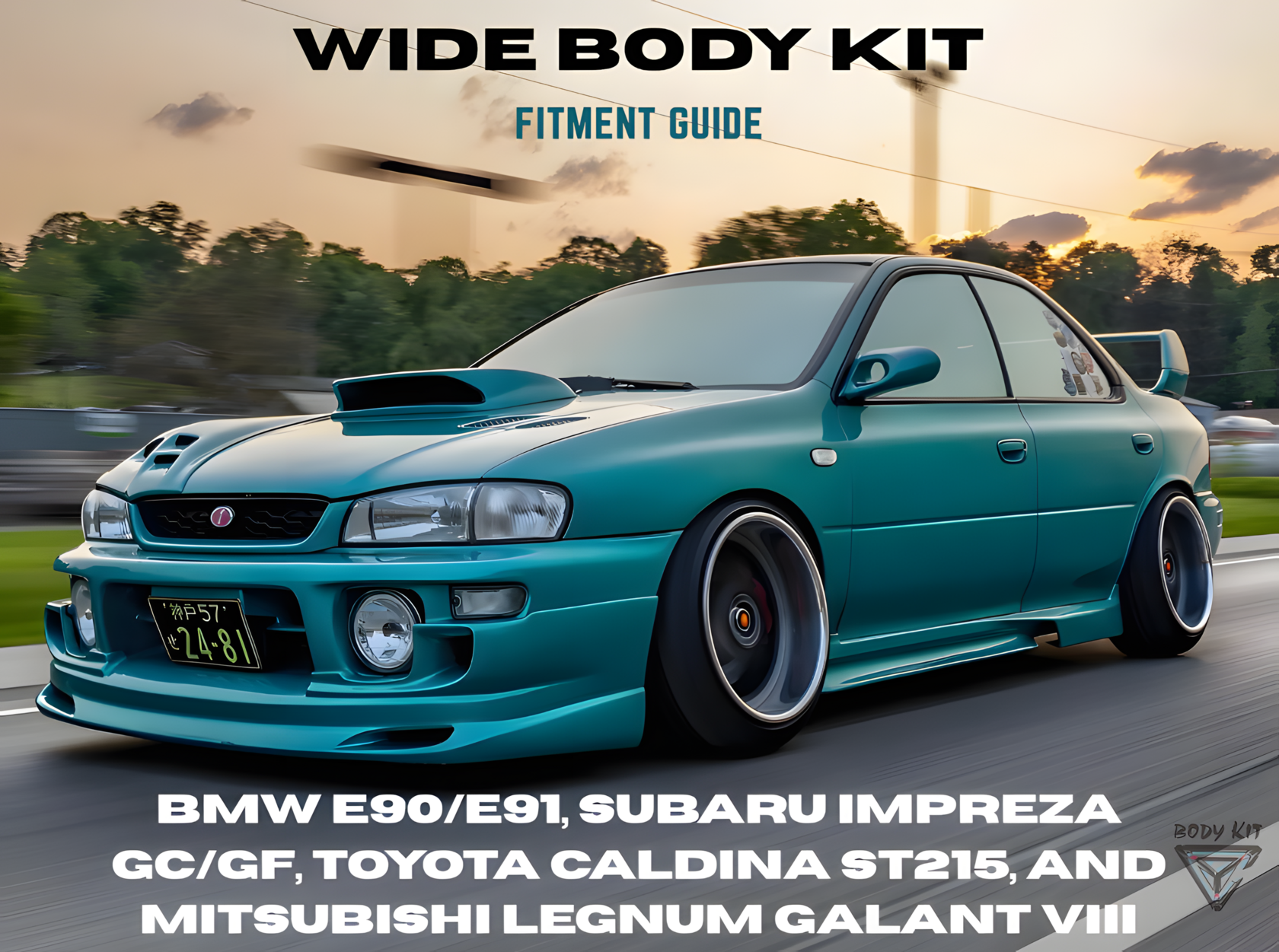
Wide Body Kit Fitment Guide: BMW E90/E91, Subaru Impreza GC/GF, Toyota Caldina ST215, and Mitsubishi Legnum Galant VIII
Written by Dmitrii Podobriaev, founder of Body Kit Online Store, with over 20 years of composite material engineering experience. Originally engineering fiberglass hulls for the marine sector (structural integrity under constant stress is non-negotiable there) Dmitrii pivoted the manufacturing operation to automotive aerodynamics in 2013. This guide reflects fitment knowledge built directly from production and customer order experience on these specific chassis.
Published: February 2026 | Last updated: February 2026
Most wide body kit purchases go wrong before a single panel is ordered. Wrong chassis code, wrong bumper spec, wrong material for the build. You're looking at panels that don't fit, a refund dispute, and a stalled project. This guide covers every real decision point specific to the BMW E90/E91, Subaru Impreza GC/GF, Toyota Caldina ST215, and Mitsubishi Legnum Galant VIII so your order arrives correct the first time and your build moves forward on schedule.
Who This Guide Is For
This is written for owners building on the E90 sedan, E91 touring, Subaru Impreza GC/GF, Toyota Caldina ST215 (210–215 chassis), or Mitsubishi Legnum Galant VIII platforms. Not generic advice. Not vague compatibility claims. Each section addresses the platform-specific variables that determine whether a kit fits or doesn't. If you're in early research, start at the materials section, it's the decision most buyers underestimate. If you've already chosen a kit style and need fitment confirmation, go directly to the chassis code section.
What Is a Wide Body Kit, and How Is It Different from a Standard Body Kit?
A wide body kit is a set of exterior panels (primarily fenders, side skirts, bumper extensions, and rear quarter panels) that replaces or overlays the factory bodywork to increase the vehicle's overall width. The purpose is to accommodate larger wheel and tire combinations, change the car's visual proportions, and on purpose-built builds, improve aerodynamic stability at the rear corners.
A standard body kit modifies the front lip, rear diffuser, or side skirts without meaningfully widening the car. A wide body kit specifically extends the front and rear fender width, typically by 30mm to 70mm per side. The distinction matters because installation scope, cost, and reversibility are fundamentally different between the two.
Full Kit vs. Partial Kit: Which One Do You Actually Need?
Full wide body kit: A complete package covering all exterior panels affected by the width conversion. For the BMW E90 and E91, this typically includes front fenders, rear quarter panel extensions (or overfenders), side skirts, a front lip, a rear bumper diffuser, and in most cases a ducktail spoiler and rear splitter. All parts are engineered to work together as a visual system, so front width matches rear and the side skirts bridge them proportionally.
Partial kit: Individual components, such as rear overfenders only or front fenders only. These are appropriate for incremental builds or when replacing a specific damaged section. Mixing partial kits from different manufacturers frequently causes proportion mismatches and panel gap inconsistencies that require significant bodywork to correct.
For the E90 and E91 models, the difference in body style plays a role in choosing rear components. The E90 is a four-door sedan, while the E91 is a five-door wagon. The roofline, shape of the rear quarter panels, and taillight configuration differ, but the rear wheel arch extensions and rear bumper trims are interchangeable. A kit designed for the E90 sedan will fit the E91 wagon without modification, and vice versa.
However, when ordering from any reputable supplier, the E90 and E91 kits should be specified separately and designed specifically for each body style, even though they are compatible. This is not a part to be guessed at or verified after purchase..
Chassis Code and Year Range: The Most Overlooked Fitment Variable
BMW E90 / E91: LCI vs. Pre-LCI
The E90/E91 generation spans 2004 to 2012, but there is a critical split within that range: the LCI (Life Cycle Impulse) facelift, introduced in 2008. The LCI refresh brought changes to the front bumper shape, headlight clusters, kidney grille design, and rear light configuration.
A front lip designed for the pre-LCI bumper will not align with the LCI bumper. When evaluating any kit for the E90 or E91, the product listing must specify:
- Pre-LCI (2004–2008)
- LCI (2008–2012)
- Or explicitly both, with compatibility notes for each
There is also the M Sport bumper consideration. Many E90 and E91 owners run the OEM M Sport front bumper, which has a different lower section from the standard bumper. Front lips designed for standard OEM bumpers do not fit M Sport bumpers without trimming or replacement. This is among the most common sources of fitment complaints and must be confirmed before purchase.
Subaru Impreza GC / GF
The GC and GF are distinct chassis codes within the same Impreza generation (1992–2001). The GC is the sedan and the GF is the hatchback/sport wagon. Rear fenders, quarter panel extensions between the two. Always verify the chassis code listed on the product. "Fits Subaru Impreza" without a chassis code is insufficient for a wide body purchase on these platforms.
Toyota Caldina ST215 (210–215 Chassis)
The Toyota Caldina is one of the most underserved platforms in the English-language aftermarket, and for builders that is both a challenge and an advantage. The second-generation Caldina spans the 190–199 (ST190/ST195) and 210–215 (ST210/ST215) chassis codes, with the ST215 being the turbocharged GT-T variant and the most common target for wide body builds. These are not interchangeable. Front bumper profiles, fender mounting points, and quarter panel geometry differ across the 190 and 210 series. Any wide body component listed for "Toyota Caldina" without a chassis code qualifier should be treated as insufficient for purchase purposes.
The ST215 GT-T shares a front strut tower layout and fender attachment geometry specific to its variant, so a kit sourced for the non-turbo ST210 will have fitment deviations at the front arch. Confirm the chassis code is listed on the product before ordering. Wide body kit documentation for this platform in English is sparse, which means most builders rely directly on the manufacturer to confirm fitment. This is normal and expected for this car.
Mitsubishi Legnum Galant VIII
The Mitsubishi Legnum is the estate (wagon) variant of the eighth-generation Galant, produced from 1996 to 2002. In chassis code terms, the EC1W/EC5W are the most commonly modified variants for wide body builds, with the VR-4 twin-turbo AWD version being the target for performance-oriented conversions. The Legnum and the Galant sedan share front geometry but differ at the rear quarter panel and D-pillar, and rear wide body components are not shared between the two body styles. Confirm whether the kit is listed for the Legnum wagon or the Galant sedan before purchasing any rear components.
Like the Caldina, authoritative English-language fitment documentation for the Legnum is limited. Confirming chassis code and body style directly with the supplier before ordering is the correct process for this platform.
Materials: The Decision Most Buyers Get Wrong
Material affects weight, flexibility, paint finish quality, repairability, and how panels respond to temperature changes over years of use. It is the most underestimated choice in the entire purchase.
Material
Weight
Flexibility
Paint Readiness
Repairability
Best Use Case
FRP (Fiberglass)
Light
Controlled elasticity
Excellent, bonds primer cleanly
High, standard body filler
Street builds, show cars, track days
Polyurethane (PU)
Heavier
High
Moderate, needs flex additive in paint
Moderate
Daily drivers, high parking-lot risk
ABS Thermoformed
Very light
Moderate
Requires sanding + adhesion primer
Low
Bolt-on flares, budget builds
Carbon Fiber
Lightest
Rigid
Raw CF needs UV clear coat
Low, specialist only
Dedicated track/weight reduction builds
FRP (Fiberglass Reinforced Plastic) is the standard for this class of kit. What separates professional-grade FRP from cheap alternatives is the lamination process and resin formulation. The FRP used in our production is hand-laid using high-grade European resins with a proprietary "controlled elasticity" characteristic. Unlike brittle mass-market fiberglass that cracks under road vibration or minor impacts, these panels are engineered to absorb torsion and flex without fracturing. The surface is finished in a technical gelcoat optimized for paint adhesion, which reduces body shop preparation time compared to raw fiberglass. The E90 chassis dimensional specifications used as the baseline for wide body fitment calculations are publicly documented through recognized automotive reference databases such as encyCARpedia's BMW E90 technical spec pages, which confirm the factory track and body measurements the kit widths are derived from.
Polyurethane absorbs minor impacts without cracking, which is a real benefit for daily drivers, but is heavier and prone to paint cracking at stress points over time when flex-capable topcoats are not applied correctly.
ABS thermoformed panels are lightweight and suit bolt-on overfender applications, but raw surface texture requires significant sanding before primer can achieve a factory-smooth finish.
Carbon fiber makes sense for dedicated track cars where every kilogram matters. Raw carbon degrades under UV without a clear coat, and carbon repair requires specialist work that most body shops cannot handle. For street-driven builds on any of the platforms covered here, the cost premium rarely returns real-world value.
For most buyers on these platforms: FRP is the right answer.
How Wide Body Kit Width Is Measured, and Why It Matters for Wheel Fitment
Wide body kit listings express additional width in millimeters per side. A kit described as "+50mm" adds 50mm to each side, for a total increase of 100mm across the vehicle.
The E90 sedan has a front track width of 1,500mm and a rear track width of 1,513mm (source: encyCARpedia BMW 320i E90 specifications). The E91 touring shares near-identical figures. Adding 50mm per side to the rear brings the potential rear track to ~1,613mm, enabling substantially wider wheels without clearance interference.
For the Subaru Impreza GC8, factory specifications list a front track of 1,470mm and rear track of 1,460mm (source: Carfolio GC8 WRX STi Version III specifications), a narrower platform, which is a relevant factor when choosing your mm extension target.
Platform
Factory Front Track
Factory Rear Track
Typical Kit Addition
Resulting Rear Track (example)
BMW E90 / E91
1,500mm
1,513mm
+40–50mm per side
~1,593–1,613mm
Subaru Impreza GC
1,470mm
1,460mm
+40–60mm per side
~1,540–1,580mm
Toyota Caldina ST215
~1,490mm
~1,490mm
+40–50mm per side
~1,570–1,590mm
Mitsubishi Legnum VR-4
~1,515mm
~1,510mm
+40–50mm per side
~1,590–1,610mm
When a kit lists different widths for front and rear (for example +40mm front and +50mm rear). This is intentional. It accounts for the car's existing front-to-rear proportion ratio. Matching front and rear additions without considering the original offset ratio can produce a visually unbalanced result even if the fitment is technically correct.
What Is Typically Included, and What Is Not
Item
Typically Included
Notes
Front fenders (left + right)
Yes
Core kit component
Rear overfenders / quarter extensions
Yes
Verify chassis code and body style
Side skirts
Yes
Bridges front-to-rear visually
Front lip
Yes
Verify LCI / pre-LCI / M Sport for BMW
Rear bumper diffuser
Yes
Usually included in full kit
Ducktail / trunk spoiler
Often
Confirm in product spec
Rear splitter
Often
Confirm in product spec
Mounting hardware (bolts, rivets, clips)
No
Source separately
Paint / primer / clear coat
No
Additional cost
Front or rear bumper shell
No
Kit works with existing shell unless stated
Installation instructions
Often not
Professional installation is assumed
Any reputable supplier should itemize the full panel count in the product listing so you know exactly what is in the box before ordering.
Installation: What "Professional Installation Required" Actually Means
This is not a legal disclaimer. It reflects the actual scope of work involved.
Installing a full wide body kit on any of the platforms covered here requires the following:
Fender trimming. The original steel or aluminum fender lip must be cut or removed to allow the wider panel to sit flat. This requires a cutting wheel, a grinder or flap wheel to smooth the edge, and rust treatment on any exposed steel. On the Subaru GC and Toyota Caldina, the rear wheel arch metal requires cutting. The Mitsubishi Legnum rear quarter is particularly involved (see the platform notes below).
Dry fitting and gap adjustment. FRP parts have slight variation from the molding process. Every panel is dry-fitted, marked, and adjusted before any adhesive or fastener is applied. Gaps between the new panel and original bodywork need to be consistent to within a few millimeters.
Bonding and fastening. Panels are bonded with panel adhesive, secured with rivets, bolted through the original panel, or a combination. Rushed bonding, the most common installation error, is the primary cause of panels separating after delivery.
Body filler and blocking. Even well-fitted FRP panels have surface contour transitions where they meet factory steel. These are filled, blocked flat, and sanded before primer. This step is unavoidable on a full conversion and accounts for a significant portion of labor time.
Paint. The entire affected area is primed, color-matched, and clear-coated. A professional paint job on a full wide body conversion involves removing door handles and trim from all affected panels.
Total labor time for a full wide body installation, excluding paint, typically runs 20 to 40 hours depending on kit complexity and original bodywork condition.
The Most Common Order Mistakes We See, and How to Avoid Them
Ordering without specifying LCI vs. pre-LCI. This is the single most frequent ordering error we encounter on the E90 platform , and in our experience it accounts for the majority of front fitment issues. The front bumper shape changed significantly with the 2008 LCI facelift, meaning a front lip or bumper extension made for one will not seat correctly on the other. Before ordering any front component, confirm your model year and cross-reference it with the 2004–2008 (pre-LCI) or 2008–2012 (LCI) split. If you're unsure, use your VIN. The FAQ entry below explains exactly how to check in under two minutes.
Ordering E90 rear components for an E91 touring. The E90 sedan and E91 touring look similar from the front, but the rear quarter panel profile, roofline drop, and taillight cutout are all different. We regularly see orders placed for the E90 sedan kit by customers who are actually building on an E91 touring , usually because the product they found was listed under "BMW 3 Series" without body style detail. The rear overfenders will not sit flush and the fitment gap will require significant filler work to mask. Always confirm body style in the product listing before checkout, and contact the supplier if the listing is ambiguous.
Not confirming M Sport vs. standard bumper before ordering a front lip. Many E90 and E91 owners have already fitted the OEM M Sport front bumper, which has a different lower opening profile from the standard bumper. A front lip designed for the standard bumper will not align correctly with the M Sport lower section . Gaps appear at the corners and the center section sits proud or low depending on the specific kit. Check whether your front bumper has a single wide lower opening (standard) or a three-section lower fascia with wider outer intakes (M Sport), and verify that the kit specifies compatibility with the correct variant.
Honest Limitations: When a Wide Body Kit Is Not the Right Choice
A wide body conversion requires cutting factory metalwork. This is irreversible without significant repair work. If you are not committed to the full build (wider wheels, adjusted suspension geometry, professional paint), a partial kit or no kit at all is the more sensible choice.
Wide body fitment also creates new inspection and registration obligations in several markets. In the EU, modified fender extensions that increase vehicle width may require a revised type approval or technical inspection. In the United States, state-level requirements on vehicle width vary. Verify local regulations before ordering.
The Subaru GC/GF rear conversion is more invasive than the E90 equivalent. The GC's rear quarter panel is structural sheet metal, not a bolt-on component. Rear work on the Impreza GC requires more metalwork hours than equivalent E90 rear work, so budget accordingly. The Mitsubishi Legnum rear quarter presents a similar level of complexity, and should be quoted explicitly with your installer before committing to the build.
If your primary goal is a reversible modification or a temporary visual change, a wide body conversion is not the right product regardless of which manufacturer you buy from. Bolt-on flares or vinyl fender extensions are better suited to that use case. We would rather lose a sale than have a customer cut their factory metalwork before they are fully committed to the build.
What to Verify Before You Order
Before completing any order, confirm the following:
- Exact chassis code is listed (E90, E91, GC, GF, ST215, EC5W, etc.): "fits BMW 3 Series" or "fits Toyota Caldina" without a chassis code is insufficient
- LCI vs. pre-LCI compatibility for any E90/E91 front components
- OEM vs. M Sport bumper compatibility if you run an M Sport front end
- Exact panel count is itemized in the product listing, not described generically
- Shipping lead time: production lead time is approximately 10–15 working days; international freight within Europe typically 7–10 days for small items and 12–20 days for large FRP kits; to the USA, Canada, and other regions typically 10–20 days depending on parcel size
- Damage claim policy: FRP panels can be damaged in transit; a reputable seller requires photos within 48 hours of delivery to process a claim
Decision Framework: Work Through These Before You Order
- What is the exact chassis code and model year?
- Is the front bumper OEM standard or M Sport (for BMW)?
- Is the goal a full visual conversion or a rear-only width addition?
- What wheel and tire width are you targeting, and does the kit's mm addition support that fitment?
- Is FRP the correct material for your intended use and paint quality expectations?
- Is professional installation available, and has the full labor scope been budgeted (including trimming, filling, and paint)?
- Has lead time been confirmed against your build schedule?
- Have local registration or inspection requirements been checked?
Frequently Asked Questions
Will the E90 widebody kit fit an E91? Only for the front components on vehicles of the same model year. The rear fender flares, rear fender flares, and rear diffusers are interchangeable between the E90 sedan and E91 wagon. The rear bumpers differ due to the roofline and body length, the shape of the side panels, and the taillight cutouts. Always select the kit specified specifically for your body type.
What does "+50mm per side" mean on a wide body kit? It means 50mm of additional width is added to each side of the vehicle, for a total increase of 100mm across the car. A "+50mm rear" kit on an E90 brings the rear track from approximately 1,513mm to approximately 1,613mm, which accommodates substantially wider rear wheels without clearance issues.
Do I need to cut my fenders to fit a wide body kit? Yes. On every platform covered here (E90, E91, GC, GF, ST215, Legnum) the original fender lip must be trimmed to allow the wider panel to sit flat against the car. This applies to both front and rear. The cut is permanent, which is one of the reasons a full commitment to the build is required before starting.
Is fiberglass or polyurethane better for a daily driver? Polyurethane survives minor impacts without cracking, which is an advantage in daily parking situations. However, it is heavier and more prone to paint cracking at stress points over time. Professional-grade FRP with controlled elasticity, as used in our production, gives a more precise fit, a cleaner paint finish, and is repairable at any standard body shop. For most builds, FRP is the better choice. For a pure daily driver in a very tight urban environment with high parking-impact risk, polyurethane has a practical case.
Does a wide body kit come with mounting hardware? No. Mounting hardware (bolts, rivets, panel clips, and adhesive) is not included in standard wide body kit listings. This is universal across kit manufacturers. Source hardware separately before installation begins.
Can I install a wide body kit myself? Technically possible, but not recommended unless you have bodywork experience. The process involves cutting factory metalwork, dry-fitting and adjusting each panel before bonding, applying body filler across transition points, and coordinating a full respray. Installation errors at the bonding stage are the leading cause of panels separating post-build. Total labor time runs 20 to 40 hours before paint. Budget professionally.
Why does the Subaru GC/GF rear conversion take longer than the BMW E90? The GC's rear quarter panel is structural sheet metal integrated into the body, not a bolt-on component. Rear work on the Impreza GC requires cutting and metalwork on a structural panel, which adds hours compared to the E90's more accessible rear quarter configuration. The Mitsubishi Legnum rear quarter presents similar complexity for the same reason.
What is the LCI on the BMW E90 and why does it affect fitment? LCI stands for Life Cycle Impulse, BMW's term for a mid-generation facelift. The E90/E91 LCI was introduced in 2008 and brought changes to the front bumper shape, headlight design, kidney grille, and rear lights. A front lip or bumper extension designed for the pre-LCI (2004–2008) bumper will not align correctly with the LCI (2008–2012) bumper. This is one of the most common ordering mistakes on the E90/E91 platform.
How long does shipping take for a wide body kit? Production lead time is approximately 10–15 working days from order confirmation. Delivery within the UK and Europe is typically 7–10 days for small items and 12–20 days for large FRP kits. To the USA, Canada, and other countries, typically 10–20 days depending on parcel size. You receive a tracking number immediately after shipment.
How do I verify my E90's LCI or pre-LCI status without guessing? Check the last seven digits of your VIN against BMW's build date records, or look at the headlight style: pre-LCI headlights have a distinct inner ring design while LCI units use an updated projector housing. The simplest method is to enter your full VIN at vindecoderz.com/EN/BMW, which will return the exact production date and factory specification, confirming whether your car is pre-LCI or LCI without any guesswork.
Is there fitment documentation available for the Toyota Caldina ST215 in English? Very little exists publicly. This platform is almost entirely undocumented in English-language aftermarket resources. The correct process for a Caldina ST215 wide body order is to contact the supplier directly with your chassis code and confirm fitment before placing the order. Any reputable manufacturer producing kits for this car should be able to confirm compatibility from the chassis code alone.
What is the difference between the Mitsubishi Legnum and the Galant for wide body fitment? The Legnum is the estate (wagon) variant of the Galant VIII. Front components are largely shared, but rear quarter panels, the D-pillar, and rear bumper geometry differ between the sedan and estate body styles. Never order rear wide body components listed for one body style and assume they will fit the other. Confirm body style in the product listing before purchase.
Further Reading and Technical References
- encyCARpedia: BMW 320i E90 Technical Specifications: Detailed factory dimension data for the E90, including confirmed front and rear track widths used as baselines for wide body fitment calculations.
- Carfolio: Subaru Impreza WRX STi GC8 Specifications: Complete factory dimension data for the GC8 sedan, including track width figures for the Subaru platform covered in this guide.
- E90Post.com: The largest English-language forum community for E90/E91/E92/E93 owners, with extensive threads on wide body fitment, wheel clearance, and LCI vs. pre-LCI modifications.
- NASIOC.com: Subaru Impreza Technical Forum: North American Subaru Impreza Owners Club, with dedicated GC/GF subforums covering chassis-specific fitment, bodywork, and suspension geometry for first-generation Impreza builds.
- VINDecoderz.com: BMW VIN Lookup: Free BMW VIN decoder that returns production date, factory specification, and build options. The most reliable way to confirm LCI vs. pre-LCI status before ordering any front body components.
Body Kit Online Store manufactures and supplies full fiberglass wide body kits for the BMW E90/E91, Subaru Impreza GC/GF, Toyota Caldina ST215, and Mitsubishi Legnum Galant VIII, with worldwide shipping. All kits are produced from 1–2mm hand-laid FRP using high-grade European resins and dispatched within 10–15 working days of order confirmation. Full kit listings and chassis-specific specifications are available at bodykitonlinestore.pro.