



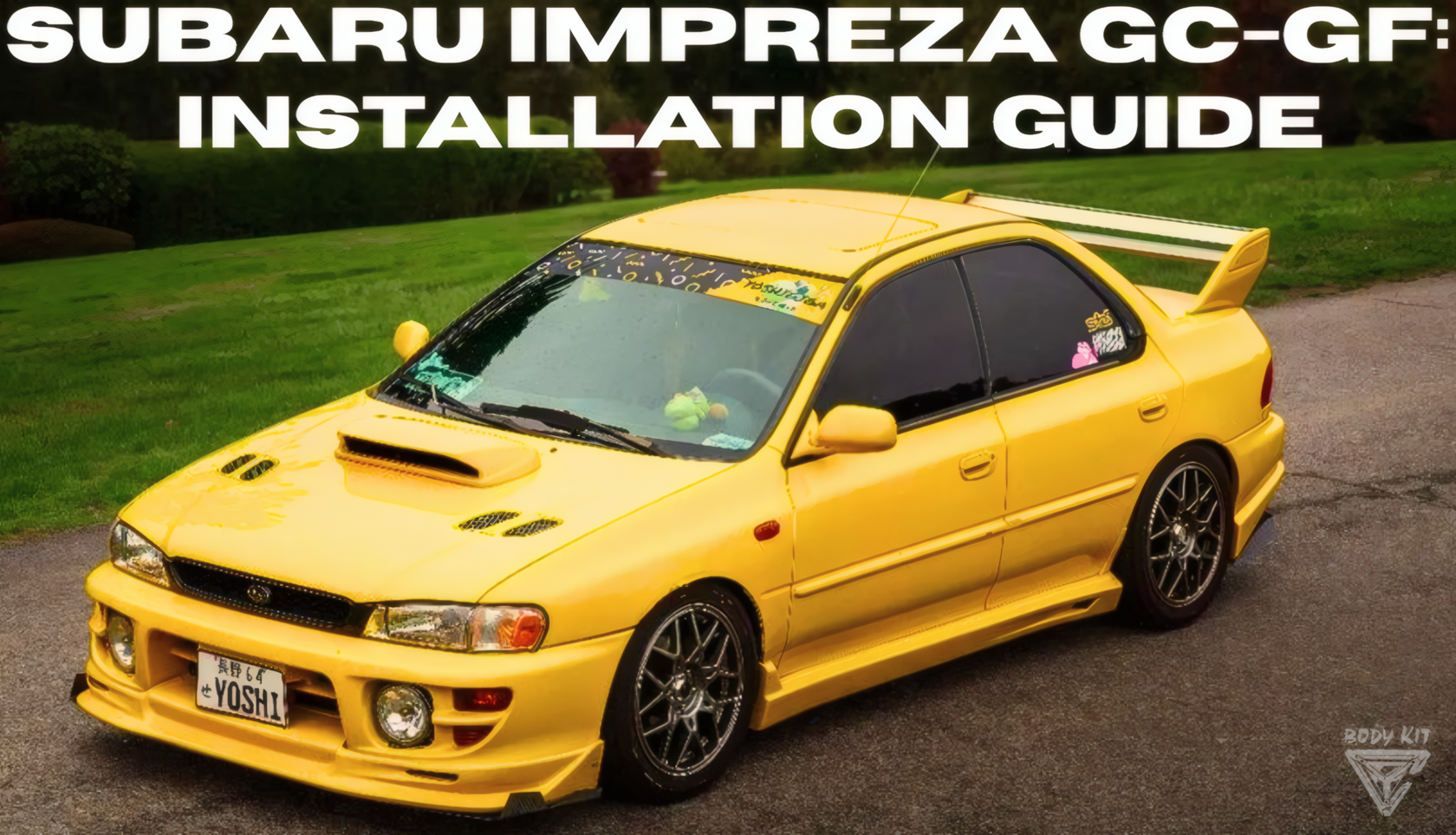
Subaru Impreza GC/GF Wide Body Kit Installation Guide: Full Process from Delivery to Paint Handoff
Written by Dmitrii Podobriaev, founder of Body Kit Online Store. 20+ years in structural composites, originally from marine construction. Automotive manufacturing since 2013. This guide reflects installation knowledge from direct production and customer order experience on the GC/GF platform.
Published: April 2026 | Last updated: April 2026 | Reading time: 14 min Applies to: Subaru Impreza GC/GF 1992–2001
Who This Guide Is For
This is for Subaru Impreza GC/GF owners and their installers preparing to fit a wide body kit. It covers the full installation sequence from receiving the panels to handing the car to the painter: what gets cut, what gets bonded, what takes longer than expected, and what to confirm before the build starts.
This guide is part of the Subaru Impreza GC/GF hub. The other articles in the cluster cover adjacent topics:
If you have not yet confirmed which chassis variant you have or whether the kit is compatible with your specific car, read the fitment guide first. This guide assumes you have already ordered and the kit is on its way.
Quick answer: The installation sequence is: inspect all panels on delivery and dry-fit everything before any cutting or bonding begins; remove front fenders, bumpers, and sill trim; cut and treat the rear arch lips (permanent modification); bond and rivet each panel in order; fill and block all panel transitions; prime; hand off to the painter with flex additive briefed at 10–15% in the colour coat and 5–10% in the clear coat. Total working time before paint: 27–43 hours. Rear arch work accounts for 12–18 hours of that total. Adhesive cure periods add several hours to the schedule and should be planned for explicitly.
What Arrives and What to Do Before Installing
Wide body kits for this platform ship in gelcoat, unpainted. A full kit covers front fenders, rear overfenders, side skirts, front lip, and rear bumper extension. Nothing is pre-painted. Nothing is intended to be.
When the kit arrives:
Tools and Materials Your Installer Will Need
Step 1: Strip the Affected Panels
Before any new panels go on, the areas they will cover or adjoin need to be stripped.
Step 2: Front Fenders: Dry Fit, Trim, and Bond
With the factory fenders off, hold each wide body fender against the mounting points and assess the fit.
The inner fender lip on the new panel is wider than the original. Before bonding, the inner arch edge of the car's wing aperture may need minor dressing to allow the new fender to sit flat. This varies by individual car. Check the gap at the top rail and along the A-pillar line before making any adjustments.
Once the dry fit is confirmed and gaps are consistent:
Front fender installation time: approximately 3–5 hours for both sides, including dry fit and bonding cure time.
Step 3: Front Lip
With the front bumper off the car, fit the front lip to the lower bumper edge on the bench.
Dry fit first. The lip should sit flush against the lower bumper face without gaps at the corners. Trim the ends of the lip if needed. Minor trimming at the outer corners is normal.
Bond the lip to the bumper lower edge using panel adhesive. Clamp and allow to cure fully before refitting the bumper to the car.
Once the adhesive has cured, refit the bumper assembly to the car. Check the gap between the lip and the ground at the centre and at both corners. It should be even. Check the alignment with the side skirts once those are fitted.
Front lip installation time: approximately 1–2 hours including cure time.
Step 4: Rear Arch Preparation (The Critical Stage)
This is the most involved part of the installation and the one most likely to be underestimated. Read this section in full before your installer starts on the rear.
The GC/GF rear quarter panel is structural sheet metal integrated into the body from the C-pillar through the arch to the bumper mounting area. The arch lip — the folded metal edge at the inner perimeter of the rear wheel arch — must be cut to allow the wider overfender to sit flat against the quarter panel surface. This cut is permanent.
The cutting sequence:
Rear arch preparation time: approximately 2–3 hours per side, including marking, cutting, dressing, and rust treatment.
Step 5: Rear Overfenders: Dry Fit, Bond, and Rivet
With the arch lip cut and treated, dry fit the rear overfender.
The overfender should sit flush against the quarter panel surface with a consistent gap around its perimeter. Check the fit at the front edge (where it meets the door), at the arch crown, and at the rear edge (where it transitions into the rear bumper line). All three points should be in contact with the quarter panel surface before any adhesive is applied.
If the fit is not consistent at all three points, identify where the overfender is standing proud and address it: either by dressing the arch lip further or by adjusting the panel position. Do not bond a panel that is not sitting correctly. Adhesive will not correct a dry fit problem.
Once the dry fit is confirmed:
Rear overfender installation time: approximately 4–6 hours per side, including dry fit, bonding, riveting, and initial gap check.
Step 6: Side Skirts
Side skirts do not require cutting. They bond to the factory sill using panel adhesive and clips.
Dry fit each skirt along the sill with the door open. The skirt should run parallel to the ground along its full length, with the top edge sitting against the sill face and the front end aligning with the front fender lower edge.
Check that the front end of the skirt aligns with the new wide body front fender. The skirt and fender lower edges should meet cleanly. This is the visual bridging point between the wider front and rear. If the front fender has been bonded and is in final position, use it as the alignment reference for the skirt's front edge.
Before bonding, check the condition of the inner sill surface. On a GC/GF at this age, inner sill corrosion can compromise the adhesive bond regardless of panel quality. If the sill surface is not solid, address it before the skirt goes on.
Once the dry fit position is confirmed, mark the sill face, apply panel adhesive, set the skirt, and clip it at the factory clip points along the sill. Tape the length of the skirt while the adhesive cures.
Side skirt installation time: approximately 1–2 hours per side.
Step 7: Rear Bumper Extension
With the rear bumper off the car, dry fit the rear bumper extension against the lower bumper edge on the car first. Confirm the fit at both corners and check alignment with the rear overfenders before any bonding takes place.
Once the dry fit position is confirmed, move to the bench. The extension should sit flush against the lower bumper face with even gaps at both corners. Trim the corners if needed. Minor adjustment at the ends is normal.
Bond to the bumper with panel adhesive, clamp, and allow to cure fully. Once cured, refit the bumper assembly to the car. Check the extension's gap to the ground and its alignment with the rear overfenders.
Rear bumper extension installation time: approximately 1–2 hours including cure time.
Step 8: Bodywork Before Paint
With all panels in final position, the car is not ready for paint. Every transition between a new FRP panel and original factory bodywork needs body filler work before the surface is paintable.
The filler-and-block stage covers:
Apply body filler to each transition area, spread flat, and allow to cure. Block sand with 80 grit to flatten the filler, then move to 180 grit to refine the surface. The goal is a surface that reads flat and continuous from panel to panel.
Once all transitions are flat, prime the entire affected surface: both front fenders, both rear arches, both sills, and both bumpers. A flexible epoxy primer is recommended for FRP panels; if standard epoxy primer is used, mix flex additive in at 5–10% on high-flex areas such as the front lip ends and skirt corners. Inspect the primed surface under good lighting. Any low spots or surface texture that was not caught during blocking will show clearly under primer. Address them before the car goes to the painter.
Filler, blocking, and primer time: approximately 8–12 hours for the full car.
Step 9: Paint Handoff
The car is ready for the painter when:
The flex additive is not optional on fiberglass body panels. Without it, the topcoat will crack at the panel edges during normal driving flex, typically within the first year. Every professional body shop that works with FRP panels knows this. If your painter is unfamiliar with the requirement, confirm it before the car goes into the booth.
Total installation time before paint: approximately 27–43 hours for a full kit on a GC or GF in good original condition. This is working time and does not include adhesive cure periods, which add several hours to the overall schedule. Plan the build timeline around cure time, not only labour hours.
What Can Go Wrong: How to Avoid It
Bonding over a dry fit problem. If a panel does not sit correctly during the dry fit, bonding it will lock that problem in permanently. Every panel must sit correctly in dry fit before adhesive is applied. This takes more time up front and saves significant rework.
Skipping rust treatment on the cut rear arch. Cut metal rusts under a fender faster than most builders expect. Treat the cut edge before the overfender goes on. It adds 20 minutes per side and prevents a structural problem that takes significant work to fix later.
Misaligned skirt front edge. The side skirt front edge alignment with the front fender lower edge is one of the most visible fitment details on the finished car. Set it correctly during the dry fit and do not bond until the alignment is confirmed. Adjusting a bonded skirt requires heat or cutting.
Insufficient filler work at the rear overfender perimeter. The transition between the overfender edge and the quarter panel surface is the largest filler area on the car. Under-blocking this section produces a visible ridge that shows clearly under paint. Block until it reads completely flat before priming.
Forgetting the flex additive. This is the most common paint-stage error on FRP builds. Brief the painter explicitly before the car enters the booth.
Frequently Asked Questions
Do I need to remove the factory rear quarter panels to fit the rear overfenders? No. The GC/GF rear quarter panel stays on the car. The rear overfenders mount over the arch, bonded and riveted to the outside of the quarter panel surface. What gets cut is the arch lip — the inner folded edge of the wheel arch opening. The quarter panel itself remains.
Can an experienced DIY builder install this kit without a body shop? The front fenders, front lip, side skirts, and rear bumper extension can be fitted by a careful DIY builder with basic bodywork tools. The rear arch cutting and the filler-and-block stage before paint require bodywork experience and equipment. Attempting the rear arches without prior metalwork experience is the most common cause of poor fitment results on this platform. If in doubt, the rear sections should be done professionally.
Does the kit come with installation instructions? No. Professional installation is assumed. This guide is the closest equivalent to installation documentation for this kit. Your installer should review it before starting.
How long should I allow for adhesive cure between stages? Panel adhesive cure time varies by product and ambient temperature. Allow a minimum of 3–4 hours at room temperature before loading a bonded panel. Full cure for load-bearing bonds is typically 24 hours. At lower ambient temperatures cure times can extend significantly beyond this. Plan the installation schedule around cure stages. Moving quickly through adhesive cure time is the most common cause of panels shifting out of alignment.
Is the kit compatible with the factory front bumper? Yes. The front lip mounts to the existing factory bumper shell. The front fenders are a replacement for the factory fenders and work with the factory bumper mounting points. No bumper replacement is required.
What happens if a panel is damaged during installation? Contact us via Telegram, Messenger, WhatsApp, or email. Minor surface damage such as small chips or edge cracks can be repaired with body filler before paint. Structural damage to a panel requires assessment. Do not attempt to bond a structurally compromised panel.
Should the flex additive go in the primer or the topcoat? A flexible epoxy primer is recommended for FRP panels. If standard epoxy primer is used, mix flex additive in at 5–10% on high-flex panel areas. In the topcoat, the flex additive is mixed into the colour coat at 10–15% by volume and into the clear coat at 5–10% by volume. Applying too high a ratio in the clear coat can compromise gloss retention and surface hardness. Your painter should confirm the exact ratio with the specific paint system they are using.
What is the correct rivet spacing on the rear overfenders? Pop rivets should be spaced at regular intervals along the inner arch edge, typically every 80–100mm. Rivets are secondary to the adhesive bond but prevent the panel edge from lifting during driving. Use the appropriate rivet diameter for the panel thickness your installer is working with and follow the adhesive manufacturer's recommended cure time before loading the riveted joint.
Summary
The Subaru Impreza GC/GF wide body kit installation follows a fixed sequence: strip the affected panels, dry fit everything before cutting or bonding anything, cut the rear arch lips and treat the exposed edges, bond and rivet each panel in order, fill and block all transitions, prime, and hand to the painter with the flex additive briefed.
The rear arch cutting stage is permanent and takes more time than the front. The filler-and-block stage before paint takes as long as the panel installation itself. Both are normal parts of a wide body conversion on this platform. Budget for them explicitly before the build starts.
Total time before paint: approximately 27–43 hours on a car in good original condition.
For chassis variant compatibility and wheel fitment planning, see the fitment guide.
Wide Body Kit (Our Development) for Subaru Impreza GC/GF
Full catalog: bodykitonlinestore.pro/subaru-impreza-gc-gf
Sources
Written by Dmitrii Podobriaev, founder of Body Kit Online Store. 20+ years in structural composites, originally from marine construction. Automotive manufacturing since 2013. This guide reflects installation knowledge from direct production and customer order experience on the GC/GF platform.
Published: April 2026 | Last updated: April 2026 | Reading time: 14 min Applies to: Subaru Impreza GC/GF 1992–2001
Who This Guide Is For
This is for Subaru Impreza GC/GF owners and their installers preparing to fit a wide body kit. It covers the full installation sequence from receiving the panels to handing the car to the painter: what gets cut, what gets bonded, what takes longer than expected, and what to confirm before the build starts.
This guide is part of the Subaru Impreza GC/GF hub. The other articles in the cluster cover adjacent topics:
- Buyer's guide: platform history, chassis background, and what the kit is
- Fitment guide: GC vs GF differences, all chassis variants, and what gets cut
If you have not yet confirmed which chassis variant you have or whether the kit is compatible with your specific car, read the fitment guide first. This guide assumes you have already ordered and the kit is on its way.
Quick answer: The installation sequence is: inspect all panels on delivery and dry-fit everything before any cutting or bonding begins; remove front fenders, bumpers, and sill trim; cut and treat the rear arch lips (permanent modification); bond and rivet each panel in order; fill and block all panel transitions; prime; hand off to the painter with flex additive briefed at 10–15% in the colour coat and 5–10% in the clear coat. Total working time before paint: 27–43 hours. Rear arch work accounts for 12–18 hours of that total. Adhesive cure periods add several hours to the schedule and should be planned for explicitly.
What Arrives and What to Do Before Installing
Wide body kits for this platform ship in gelcoat, unpainted. A full kit covers front fenders, rear overfenders, side skirts, front lip, and rear bumper extension. Nothing is pre-painted. Nothing is intended to be.
When the kit arrives:
- Inspect every panel before your installer begins any work. Photograph all surfaces and edges on delivery day. If anything is damaged in transit, report it with photos within 48 hours. Claims submitted after that cannot be processed.
- Do a dry fit of all panels before any cutting or bonding begins. Lay each panel against its mounting position on the car and assess the gaps. Dry fitting is where fitment decisions are made. It is not optional.
- Source mounting hardware before installation starts. Bolts, rivets, panel clips, and panel adhesive are not included with the kit. Your installer should have these ready before the car goes on the lift.
Tools and Materials Your Installer Will Need
- Cutting wheel and angle grinder with flap wheel attachment: for trimming and dressing the rear arch lips
- Body panel adhesive: for bonding fenders, overfenders, and skirts to the car
- Pop rivets or self-tapping screws: secondary fastening at panel edges
- Measuring tape and panel gap tools: for consistent gap assessment during dry fit
- Body filler and spreader: for bridging transitions between new panels and factory bodywork
- Sanding blocks, 80 and 180 grit: for flatting filler before primer
- Rust treatment or weld-through primer: for cut metal edges on the rear arches
- DA sander: for final surface prep before paint handoff
- Flex additive: to be mixed into the colour coat at 10–15% by volume and into the clear coat at 5–10% by volume; the painter handles this, not the installer
Step 1: Strip the Affected Panels
Before any new panels go on, the areas they will cover or adjoin need to be stripped.
- Remove the front fenders. On the GC/GF, the front fenders are bolt-on panels. They detach from the A-pillar, the inner wing, and the top mounting rail. Remove the front fenders from both sides and set them aside. They will not be refitted.
- Remove the front bumper. The front lip mounts below the bumper, so the bumper needs to come off for access. Mark the bumper alignment before removing it so it goes back at the same height.
- Remove the door sill trim on both sides. The side skirts bond along the factory sill, so the plastic trim needs to be off before dry-fitting the skirts.
- Remove the rear bumper. The rear bumper extension mounts to the lower edge of the factory bumper shell. Take the bumper off, fit the extension to it on the bench, and refit as an assembly.
- Do not remove the rear quarter panels. The GC/GF rear quarter is structural sheet metal. It stays on the car. The rear overfenders mount over and around the arch, not in place of the quarter panel.
Step 2: Front Fenders: Dry Fit, Trim, and Bond
With the factory fenders off, hold each wide body fender against the mounting points and assess the fit.
The inner fender lip on the new panel is wider than the original. Before bonding, the inner arch edge of the car's wing aperture may need minor dressing to allow the new fender to sit flat. This varies by individual car. Check the gap at the top rail and along the A-pillar line before making any adjustments.
Once the dry fit is confirmed and gaps are consistent:
- Apply panel adhesive along the inner mounting flange of the fender. Work evenly and do not concentrate adhesive at one point.
- Set the fender against the car, confirm alignment with the door gap and bonnet line, and clamp or tape in position while the adhesive cures.
- Once cured, add bolts or rivets at the mounting points for permanent fastening.
- Check the gap between the fender edge and the door at multiple points. Gaps should be consistent. If a gap is uneven, address it before the car goes to paint.
Front fender installation time: approximately 3–5 hours for both sides, including dry fit and bonding cure time.
Step 3: Front Lip
With the front bumper off the car, fit the front lip to the lower bumper edge on the bench.
Dry fit first. The lip should sit flush against the lower bumper face without gaps at the corners. Trim the ends of the lip if needed. Minor trimming at the outer corners is normal.
Bond the lip to the bumper lower edge using panel adhesive. Clamp and allow to cure fully before refitting the bumper to the car.
Once the adhesive has cured, refit the bumper assembly to the car. Check the gap between the lip and the ground at the centre and at both corners. It should be even. Check the alignment with the side skirts once those are fitted.
Front lip installation time: approximately 1–2 hours including cure time.
Step 4: Rear Arch Preparation (The Critical Stage)
This is the most involved part of the installation and the one most likely to be underestimated. Read this section in full before your installer starts on the rear.
The GC/GF rear quarter panel is structural sheet metal integrated into the body from the C-pillar through the arch to the bumper mounting area. The arch lip — the folded metal edge at the inner perimeter of the rear wheel arch — must be cut to allow the wider overfender to sit flat against the quarter panel surface. This cut is permanent.
The cutting sequence:
- Mark the cut line on the inside of the rear arch lip. The line follows the inner edge of the arch opening, set back far enough that the overfender will sit flat without the folded lip pushing it away from the panel surface. Dry fit the overfender first, mark where the lip needs to go, then remove the overfender before cutting. Do not guess this measurement.
- Cut along the marked line with a cutting wheel. Work in sections if needed. The cut does not need to be perfect at this stage. It will be dressed back.
- Dress the cut edge with a flap wheel until it is flat and smooth. There should be no sharp edges or raised burrs that could push the overfender panel away from the surface.
- Treat the cut metal edge immediately. Exposed steel rusts quickly, even under a fender. Apply rust treatment or weld-through primer to the entire cut edge before the overfender goes on. This step is skipped more often than it should be and is the primary cause of rust appearing at the rear arch after a wide body conversion on this platform.
Rear arch preparation time: approximately 2–3 hours per side, including marking, cutting, dressing, and rust treatment.
Step 5: Rear Overfenders: Dry Fit, Bond, and Rivet
With the arch lip cut and treated, dry fit the rear overfender.
The overfender should sit flush against the quarter panel surface with a consistent gap around its perimeter. Check the fit at the front edge (where it meets the door), at the arch crown, and at the rear edge (where it transitions into the rear bumper line). All three points should be in contact with the quarter panel surface before any adhesive is applied.
If the fit is not consistent at all three points, identify where the overfender is standing proud and address it: either by dressing the arch lip further or by adjusting the panel position. Do not bond a panel that is not sitting correctly. Adhesive will not correct a dry fit problem.
Once the dry fit is confirmed:
- Apply panel adhesive to the inner face of the overfender at the mounting flange. Apply a secondary bead along the arch contact surface.
- Set the overfender in position and clamp firmly. Tape can be used to hold the edges while the adhesive cures.
- Once cured, add pop rivets along the inner arch edge at regular intervals, typically every 80–100mm. Rivets are secondary to the adhesive bond but prevent the panel edge from lifting during driving.
- Check the front edge of the overfender against the door gap and the rear edge against the bumper line. Both should be flush.
Rear overfender installation time: approximately 4–6 hours per side, including dry fit, bonding, riveting, and initial gap check.
Step 6: Side Skirts
Side skirts do not require cutting. They bond to the factory sill using panel adhesive and clips.
Dry fit each skirt along the sill with the door open. The skirt should run parallel to the ground along its full length, with the top edge sitting against the sill face and the front end aligning with the front fender lower edge.
Check that the front end of the skirt aligns with the new wide body front fender. The skirt and fender lower edges should meet cleanly. This is the visual bridging point between the wider front and rear. If the front fender has been bonded and is in final position, use it as the alignment reference for the skirt's front edge.
Before bonding, check the condition of the inner sill surface. On a GC/GF at this age, inner sill corrosion can compromise the adhesive bond regardless of panel quality. If the sill surface is not solid, address it before the skirt goes on.
Once the dry fit position is confirmed, mark the sill face, apply panel adhesive, set the skirt, and clip it at the factory clip points along the sill. Tape the length of the skirt while the adhesive cures.
Side skirt installation time: approximately 1–2 hours per side.
Step 7: Rear Bumper Extension
With the rear bumper off the car, dry fit the rear bumper extension against the lower bumper edge on the car first. Confirm the fit at both corners and check alignment with the rear overfenders before any bonding takes place.
Once the dry fit position is confirmed, move to the bench. The extension should sit flush against the lower bumper face with even gaps at both corners. Trim the corners if needed. Minor adjustment at the ends is normal.
Bond to the bumper with panel adhesive, clamp, and allow to cure fully. Once cured, refit the bumper assembly to the car. Check the extension's gap to the ground and its alignment with the rear overfenders.
Rear bumper extension installation time: approximately 1–2 hours including cure time.
Step 8: Bodywork Before Paint
With all panels in final position, the car is not ready for paint. Every transition between a new FRP panel and original factory bodywork needs body filler work before the surface is paintable.
The filler-and-block stage covers:
- The transition between each front fender edge and the A-pillar or wing aperture
- The rear overfender perimeter where it meets the quarter panel surface
- Any minor surface variation along the sill at the skirt mounting line
- The front and rear bumper extension corners where they join the factory bumper face
Apply body filler to each transition area, spread flat, and allow to cure. Block sand with 80 grit to flatten the filler, then move to 180 grit to refine the surface. The goal is a surface that reads flat and continuous from panel to panel.
Once all transitions are flat, prime the entire affected surface: both front fenders, both rear arches, both sills, and both bumpers. A flexible epoxy primer is recommended for FRP panels; if standard epoxy primer is used, mix flex additive in at 5–10% on high-flex areas such as the front lip ends and skirt corners. Inspect the primed surface under good lighting. Any low spots or surface texture that was not caught during blocking will show clearly under primer. Address them before the car goes to the painter.
Filler, blocking, and primer time: approximately 8–12 hours for the full car.
Step 9: Paint Handoff
The car is ready for the painter when:
- All panels are bonded and riveted in final position
- All transitions are filled, blocked, and primed
- Gaps between panels are consistent and correct
- The painter has been briefed on the flex additive requirement: 10–15% by volume in the colour coat and 5–10% by volume in the clear coat on all FRP panels
The flex additive is not optional on fiberglass body panels. Without it, the topcoat will crack at the panel edges during normal driving flex, typically within the first year. Every professional body shop that works with FRP panels knows this. If your painter is unfamiliar with the requirement, confirm it before the car goes into the booth.
Total installation time before paint: approximately 27–43 hours for a full kit on a GC or GF in good original condition. This is working time and does not include adhesive cure periods, which add several hours to the overall schedule. Plan the build timeline around cure time, not only labour hours.
What Can Go Wrong: How to Avoid It
Bonding over a dry fit problem. If a panel does not sit correctly during the dry fit, bonding it will lock that problem in permanently. Every panel must sit correctly in dry fit before adhesive is applied. This takes more time up front and saves significant rework.
Skipping rust treatment on the cut rear arch. Cut metal rusts under a fender faster than most builders expect. Treat the cut edge before the overfender goes on. It adds 20 minutes per side and prevents a structural problem that takes significant work to fix later.
Misaligned skirt front edge. The side skirt front edge alignment with the front fender lower edge is one of the most visible fitment details on the finished car. Set it correctly during the dry fit and do not bond until the alignment is confirmed. Adjusting a bonded skirt requires heat or cutting.
Insufficient filler work at the rear overfender perimeter. The transition between the overfender edge and the quarter panel surface is the largest filler area on the car. Under-blocking this section produces a visible ridge that shows clearly under paint. Block until it reads completely flat before priming.
Forgetting the flex additive. This is the most common paint-stage error on FRP builds. Brief the painter explicitly before the car enters the booth.
Frequently Asked Questions
Do I need to remove the factory rear quarter panels to fit the rear overfenders? No. The GC/GF rear quarter panel stays on the car. The rear overfenders mount over the arch, bonded and riveted to the outside of the quarter panel surface. What gets cut is the arch lip — the inner folded edge of the wheel arch opening. The quarter panel itself remains.
Can an experienced DIY builder install this kit without a body shop? The front fenders, front lip, side skirts, and rear bumper extension can be fitted by a careful DIY builder with basic bodywork tools. The rear arch cutting and the filler-and-block stage before paint require bodywork experience and equipment. Attempting the rear arches without prior metalwork experience is the most common cause of poor fitment results on this platform. If in doubt, the rear sections should be done professionally.
Does the kit come with installation instructions? No. Professional installation is assumed. This guide is the closest equivalent to installation documentation for this kit. Your installer should review it before starting.
How long should I allow for adhesive cure between stages? Panel adhesive cure time varies by product and ambient temperature. Allow a minimum of 3–4 hours at room temperature before loading a bonded panel. Full cure for load-bearing bonds is typically 24 hours. At lower ambient temperatures cure times can extend significantly beyond this. Plan the installation schedule around cure stages. Moving quickly through adhesive cure time is the most common cause of panels shifting out of alignment.
Is the kit compatible with the factory front bumper? Yes. The front lip mounts to the existing factory bumper shell. The front fenders are a replacement for the factory fenders and work with the factory bumper mounting points. No bumper replacement is required.
What happens if a panel is damaged during installation? Contact us via Telegram, Messenger, WhatsApp, or email. Minor surface damage such as small chips or edge cracks can be repaired with body filler before paint. Structural damage to a panel requires assessment. Do not attempt to bond a structurally compromised panel.
Should the flex additive go in the primer or the topcoat? A flexible epoxy primer is recommended for FRP panels. If standard epoxy primer is used, mix flex additive in at 5–10% on high-flex panel areas. In the topcoat, the flex additive is mixed into the colour coat at 10–15% by volume and into the clear coat at 5–10% by volume. Applying too high a ratio in the clear coat can compromise gloss retention and surface hardness. Your painter should confirm the exact ratio with the specific paint system they are using.
What is the correct rivet spacing on the rear overfenders? Pop rivets should be spaced at regular intervals along the inner arch edge, typically every 80–100mm. Rivets are secondary to the adhesive bond but prevent the panel edge from lifting during driving. Use the appropriate rivet diameter for the panel thickness your installer is working with and follow the adhesive manufacturer's recommended cure time before loading the riveted joint.
Summary
The Subaru Impreza GC/GF wide body kit installation follows a fixed sequence: strip the affected panels, dry fit everything before cutting or bonding anything, cut the rear arch lips and treat the exposed edges, bond and rivet each panel in order, fill and block all transitions, prime, and hand to the painter with the flex additive briefed.
The rear arch cutting stage is permanent and takes more time than the front. The filler-and-block stage before paint takes as long as the panel installation itself. Both are normal parts of a wide body conversion on this platform. Budget for them explicitly before the build starts.
Total time before paint: approximately 27–43 hours on a car in good original condition.
For chassis variant compatibility and wheel fitment planning, see the fitment guide.
Wide Body Kit (Our Development) for Subaru Impreza GC/GF
Full catalog: bodykitonlinestore.pro/subaru-impreza-gc-gf
Sources
- Subaru GC8/GF8 Factory Body Repair Manual (Subaru of America, 1992–2001): rear quarter panel construction specifications and arch geometry documentation
- PPG Industries / Axalta technical guidance on flex additives in FRP refinishing: recommended ratios and application methods for flexible substrates
- Body Kit Online Store installation records: GC/GF build process data and common error patterns compiled from customer installations, 2015–2026